Case Study

Making a Commerce Platform Readable to AI Engines

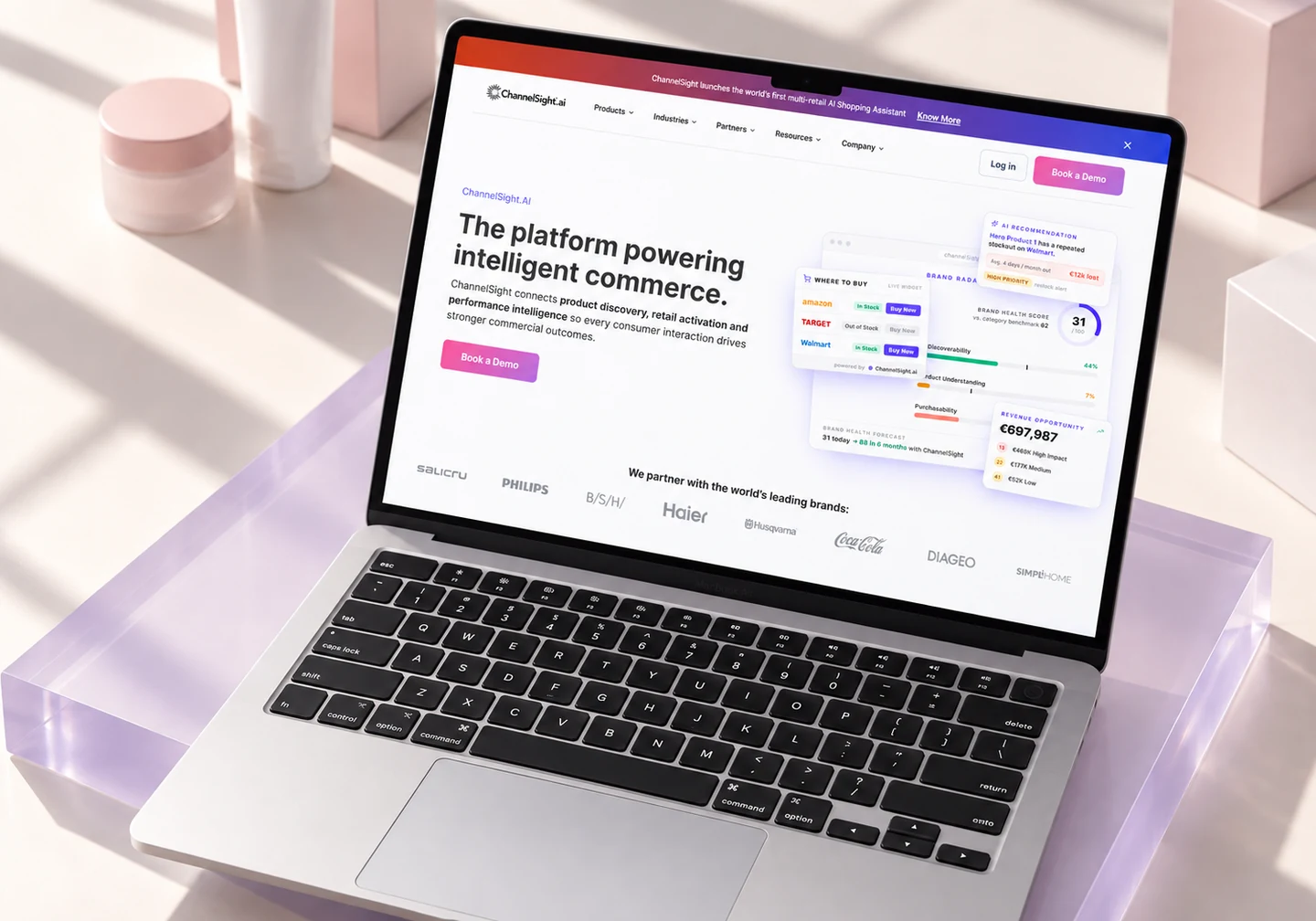
ChannelSight homepage on a silver MacBook on lavender acrylic among retail packaging.
ChannelSight. Technical search improvements and ongoing Webflow development.
most-cited source across six AI assistants
No. 1
case studies rebuilt on reusable sections
15
new industry pages live
8
The Challenge

The only company in its category that AI engines could not read.

ChannelSight is a where-to-buy and digital shelf platform for consumer brands. It connects buy-now intent on a brand's website, media and campaigns to live retailer product pages, and measures the whole path from content to checkout.

The company was repositioning around AI and agentic commerce, and its own site published no structured data at all. Not on the homepage, not on the product pages, not even on the FAQ page where the answers were already written. Every direct competitor published it. In mid-June, zero pages on ChannelSight's site carried it.

Search told the same story. 371 blog posts and all 14 case studies were going out with empty search titles or descriptions, the homepage title read ChannelSight.ai and nothing else, and crawlers were spending their time on 2,349 junk URLs. On our own 100-point readability audit the site scored 30.

The Solution

Making every page legible to machines.

Structured Data, Site-Wide

Organization markup across the site and Article markup on every blog post, plus FAQ and Breadcrumb. Then JSON-LD written by hand onto the 33 pages that do the selling: five product pages marked up as software, the how-it-works set, and 19 topic cluster pages.

The Snippets and Titles the Site Never Had

371 blog posts and all 14 case studies were given a written search title and description, each built from that page's own summary or opening lines. 385 pages in total. The homepage title went from a bare brand name to a line that says what the company actually does.

Crawl Budget Pointed at Real Pages

Pagination was blocked in the robots file so engines stopped crawling thousands of near-duplicate URLs, and every page was given a canonical tag declaring its own address. A hand-written llms.txt replaced a 714-line generated file whose homepage entry was blank.

The Outcome

The most-cited domain in the sample.

475 Pages Machine-Readable, From Zero

A full crawl of all 586 pages on 15 July confirmed 475 carrying structured data, where mid-June had none. Low-value URLs in the crawl fell from 2,349 to 410, a drop of 83%.

385 Pages Given a Search Snippet

Every one of the 371 blog posts and 14 case studies that had been publishing blank now carries a written title and description, so the result says what the page is about before anyone clicks.

Readability Score, 30 to 59

Our own 100-point audit, re-run identically two months later. The two categories the June audit called lowest and highest-leverage are the two that moved: structured data 0 to 18 of 30, technical foundations 1 to 12 of 25.

Most-Cited Domain in the Panel

Fourteen real buyer questions went to ChatGPT, Claude, Perplexity and Gemini on 15 July 2026. channelsight.com was the most-cited domain of any kind, ahead of MikMak, Pear and Wayvia combined. Weekly checks across six AI assistants still ranked it first on 12 October 2026.

Built to Be Re-Measured

The June baseline existed to be re-run: same checks, same scoring, same crawl. Every number here is a before and an after taken the same way, so the next round is measured rather than asserted.